

It Takes a Valley
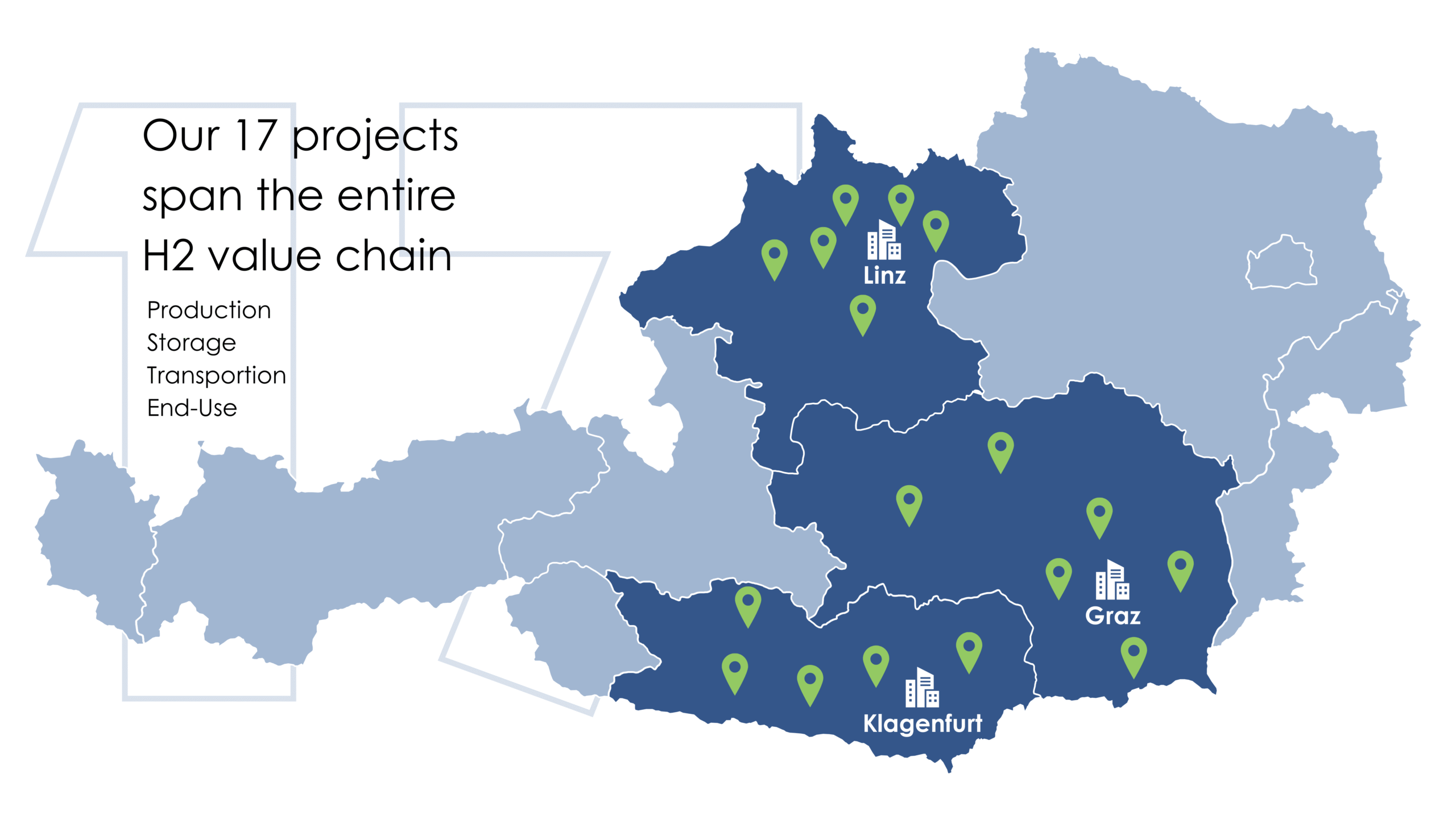
HI2 Valley (Hydrogen Industrial Inland Valley) is located in Austria and consists of 17 distinct hydrogen projects, co-funded by the European Union.
The overall project has a time frame of 6 years and a budget of € 588 million – € 20 million of which are granted in EU funding volume.
In total, 44 Austrian and international partners have joined the HI2 Valley across the regions of Carinthia, Styria and Upper Austria.
Knowledge is Power
Hydrogen relies on more than pipes and electrolysers: Communities need the know-how to work and sustain new infrastructure.
The HI2 Valley will undertake projects in training and skill development, including summer schools, classes for students, webinars and specialised training courses. The training activities will be carried out by a mix of industry experts and academics.
MW combined electrolyzer effect
tonnes/year hydrogen produced
CO2-equivalent saved
Built to scale
HI2 Valley is positioned to act as a crucial hydrogen bridge between Southern- and Eastern Europe. Here it will be able to integrate into a Central European network of sustainable energy, starting with connections to Germany, Italy and Slovakia.
The HI2 Valley will also carry out technical studies in Romania, Poland, Hungary, Czech Republic and Latvia to determine how the project might be replicated in future hydrogen-valley projects.
Carinthia
The HI2 Valley will contribute towards the region’s goals in decarbonizing industry and mobility in particular. In the south, the planned SoutH2Corridor can link the HI2 Valley to Italy and potentially extend into Africa. The HI2 Valley projects in the region are positioned strategically along this corridor as well as the Ten-T Baltic Adriatic Corridor– a European north/south transportation network spanning from northern Poland to northern Italy and the Western Balkans – Eastern Mediterranean Corridor.
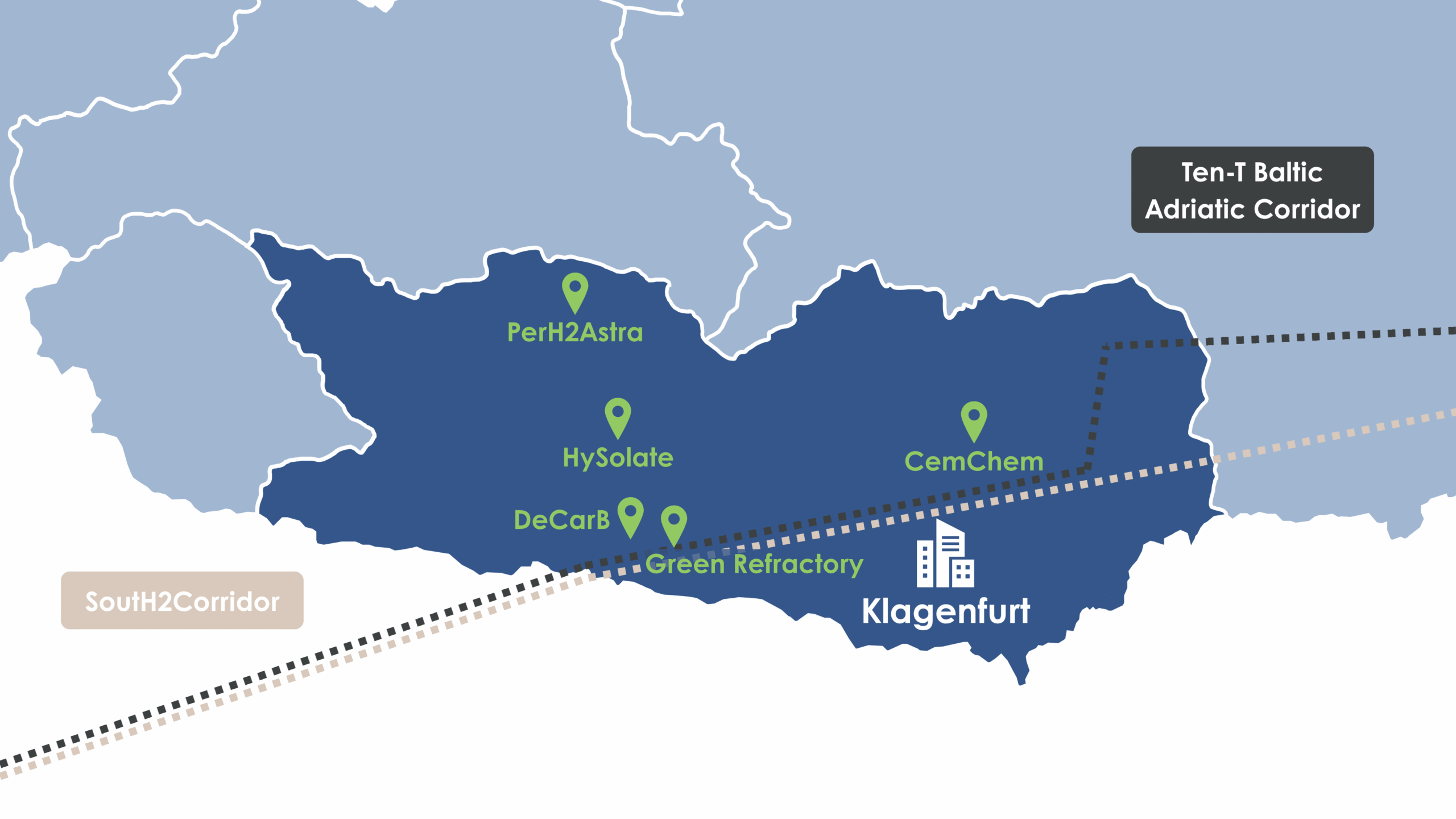
PerH2Astra
Local warming
The biomass-fuelled Astra Biowärme in the town Rennweg am Katschberg is one of Carinthia’s clean heating plants.
To fully decarbonize, the project PerH2Astra plans to construct a new 2MW hydropower plant and install a 500 kW electrolyser.
The produced hydrogen can supply hydrogen-powered trucks for transporting wood chips to the biomass plant, as well as supplying public, hydrogen-powered buses used by the Carinthian travel company Bacher Touristik.
In another step to reduce the carbon footprint, the heating plant intends to replace its currently used diesel-powered wood choppers with electrified alternatives.
Involved partners: Astra Biowärme, Bacher Touristik, HyCentA
Green Refractory
Taking the heat
The production of heat- and chemical-resistant materials can be supported using sustainable hydrogen.
For this purpose, the project Green Refractory plans to commission a 5 MW electrolyser near the city of Villach.
The power for hydrogen production is planned to be supplied by the energy company KELAG-Kärntner Energie-Aktiengesellschaft using sustainable energy sources from hydropower, as well as solar panels and wind turbines.
The hydrogen peroxide producer Evonik Peroxid in the city of Weißenstein and the refractory product producer RHI Magnesita in the city of Radenthein have joined the project as potential hydrogen off-takers.
Hydrogen production also requires efficient means of transporting the hydrogen to its point of intended use. Within the project scope, the electricity and gas distributor KNG-Kärnten Netz plans to locate new pipeline routes for hydrogen transportation.
Involved partners: KELAG-Kärntner Energie-Aktiengesellschaft, Evonik Peroxid, RHI Magnesita, KNG-Kärnten Netz
CemChem
Steeled for efficiency
Hydrogen opens up new ways for industries to work together – and clever collaboration raises the efficiency bar in the valley project CemChem in the districts of St. Veit and Völkermarkt.
The chemicals manufacturer Donau Chemie Aktiengesellschaft plans to install a new 5 MW electrolyser in eastern Carinthia near Brückl. In the course of a feasibility study, Wietersdorfer Alpacem in Wietersdorf is testing its use in cement production, and the materials producer Treibacher Industrie in the city Althofen. Additionally, the industrial tubing producer Fischer Edelstahlrohre Austria in Griffen wants to substitute external hydrogen delivery with its own local production of green hydrogen.
Temporarily, Trailers are planned to transport hydrogen between the project partners. For long term perspective KNG as local distribution gas grid operater is working on a concept for a new H2 grid connection between the SouthH2Corridor and the project partners as well.
The new collaboration also means increased need for sustainable energy. The project partners could expand their output of solar power to meet the coming demand.
Involved partners: HyCentA, Donau Chemie Aktiengesellschaft, Wietersdorfer Alpacem, Treibacher Industrie, Fischer Edelstahlrohre Austria, KNG
HySolate
Innovative outputs
Northwest of the city of Villach and within reach of project Green Refractory, the insulation producer Knauf is making moves into green hydrogen.
For a newly planned recycling plant in Ferndorf they develop a H2-ready gas burner to be able to replace natural gas by switching to green hydrogen when in the future it is readily available via pipeline. By using synergies with the planned pipeline in the Green Refractory project, HySolate would only need a few hundred meters of additional pipeline by the Carinthian power grid operator KNG-Kärnten-Netz.
Involved partners: Knauf Insulation, KNG-Kärnten Netz, HyCentA
DeCarB
Within the HI2 Valley, the DeCarB project serves as a key hydrogen mobility initiative.
Public transport in the rural Villach region is planned to be fully converted to FCEV buses, supported by a new HRS, 35 buses and a 2 MW electrolyzer. To secure local hydrogen supply for ramp-in activities, particularly in the mobility sector, KELAG plans to extend the initially planned electrolyser capacity by an additional megawatt (3 MW in total).
This expansion aims to supply not only public transport operators but also further off-takers in the Villach region with green hydrogen.
Involved partners: KELAG, HyCentA
CSH2H Donawitz
Wheels of industry
Hydrogen has many uses: In addition to fuelling power plants that power electrical sockets, it also integrates directly into industrial processes, and it makes vehicles go.
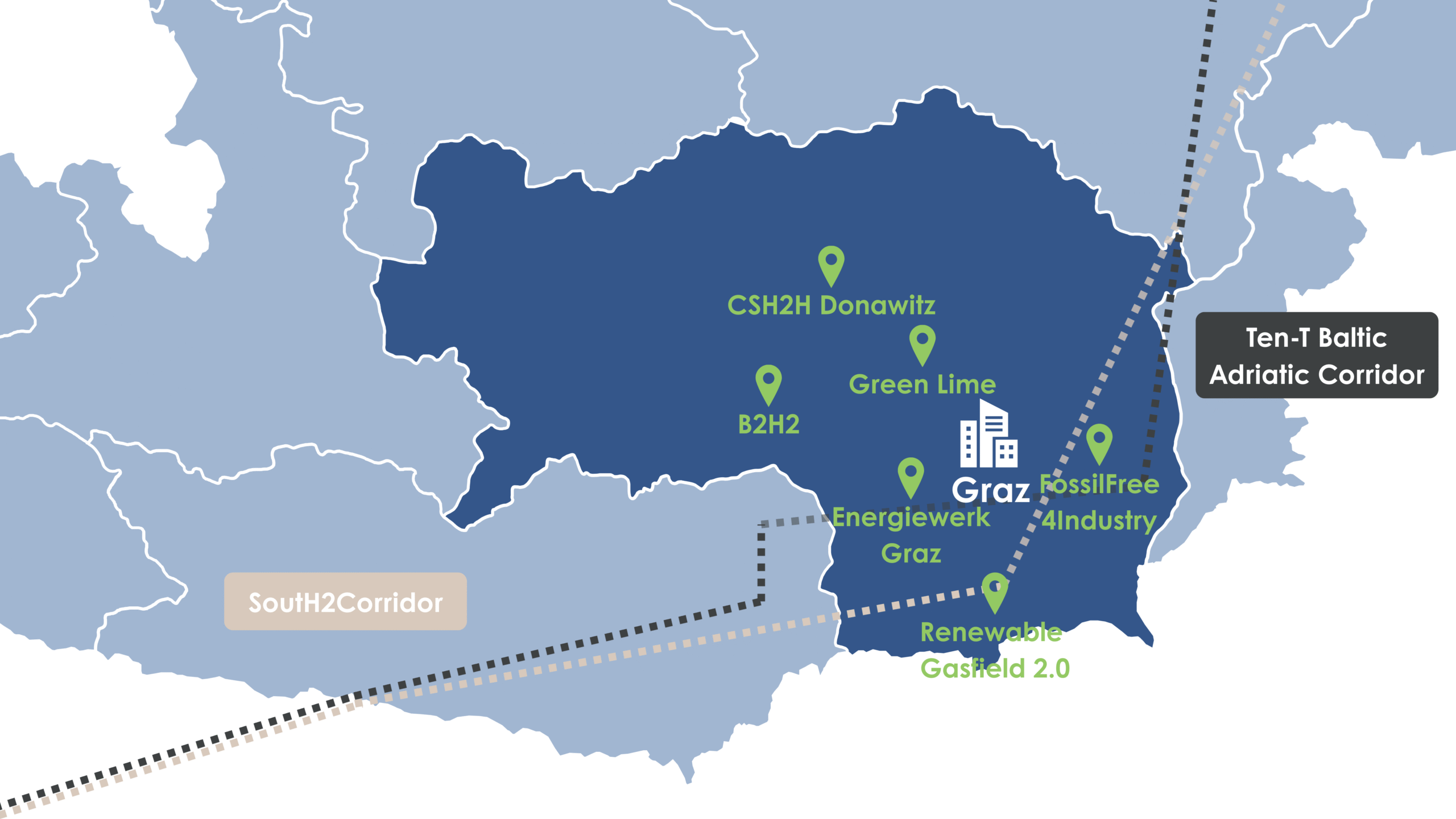
Commissioning a substantial 20 MW electrolyser, the steel producer Voestalpine plans to produce 2842 tonnes of renewable hydrogen per year northwest of the city of Graz.
The hydrogen will not only be used as a component for steel production, but also mobility.
The energy company Energie Steiermark Wasserstoff GmbH will deliver a hydrogen refuelling station, allowing a projected total of 187 vehicles to utilize the produced hydrogen. These include trucks belonging to a transport company and a brewing company.
Involved partners: voestalpine, Energie Steiermark Wasserstoff GmbH
Green Lime
Tastefully named trials
This lime might be ‘green’, but it’s not for eating. The Green Lime project north of Graz instead deals with the calcium material that’s familiar to most in the form of limestone.
Within the project framework, the lime-producer InterCal Austria will test whether a mixture of hydrogen and natural gas can provide the heat needed for cement production in their production site near the city of Peggau.
This is one example of how clean hydrogen has the potential to decarbonize the cement industry, one of the most energy-intensive and hard-to-abate sectors globally.
Trailers from project CSH2H Donawitz will deliver the initial hydrogen. Pending the outcome of the trials, InterCal Austria will cooperate with the energy company Energie Steiermark Wasserstoff GmbH to repurpose existing gas pipelines to meet increasing hydrogen demand.
Involved partners: InterCal Austria, HyCentA, Energie Steiermark Wasserstoff GmbH
Energiewerk Graz
Waste-powered progress
At the powerplant Energiewerk Graz, the reuse and recycling of refuse already helps to reduce the remaining amount of residual waste in Graz.
But even non-recyclables have their (re)use, as the powerplant converts a formidable 110,000 tonnes of residual waste to energy every year.
Coupling a 3 MW electrolyser to the waste utilisation plant will result in a projected output of 450 tonnes of green hydrogen per year. This hydrogen will be used in mobility and industry.
A rail connection using specialised hydrogen storage containers will allow transportation.
Involved partners: Energiewerk Graz
FossilFree4Industry
Sustainability on tap
Hydrogen is naturally gaseous, so it might be no surprise it’s a contender for the gas grid of the future.
The energy company Energie Steiermark Wasserstoff GmbH plans an 8 MW electrolyser to support sustainable industry east of the city of Graz.
The output will consist of 1150 tonnes of mostly hydrogen and, for a smaller part, biomethane, to be injected directly into the natural gas grid for use in industrial production.
The project involves designing new gas, heat and electricity infrastructure to neighboring regions of Gleisdorf and Weiz. In addition, the viability of a refuelling station for hydrogen-powered vehicles is also being examined.
Involved partner: Energie Steiermark Wasserstoff GmbH
Renewable Gasfield 2.0
Addition by reduction
‘Reduction’ is the name of an important chemical reaction essential to many industrial processes. And clean hydrogen is well-suited for the chemical reduction of the metal tungsten.
For this purpose, the energy company Energie Steiermark Wasserstoff GmbH will a 1 MW electrolyser added to the already existing 1 MW electrolyser with locally produced solar energy, producing 150 tonnes of hydrogen per year in the project Renewable Gasfield 2.0
The Renewable Gasfield is located south of Graz, close to the Slovenian border, and it already produces methane for the natural gas grid using green hydrogen and CO2 from biogas plants.
The project was conceived with modularity in mind, and as such it has extended smoothly within the Hydrogen Valley framework.
Involved partner: Energie Steiermark Wasserstoff GmbH
B2H2
Tech chipping in
Stripping hydrogen from water using renewable energy is not the only way of producing green hydrogen.
The B2H2 project west of Graz instead sets out to turn wood chips into hydrogen. Through a complex biotechnology process involving many steps, the Advanced Bioenergy Lab eGen will convert gas produced from a woodchip-fed bioplant into ready-to-use hydrogen. The competence centre BEST – Bioenergy and Sustainable Technologies will serve as a know-how provider in various stages of the project, including the development of technical guidelines and standards.
An Austrian fuel, chemical and materials company plans to take off 500-600 tonnes of produced hydrogen per year for their hydrogen demand in their refinery, delivered by trailers.
Involved partners: Advanced Bioenergy Lab eGen, BEST – Bioenergy and Sustainable Technologies
Styria
Styria is Austria’s leading hydrogen research hotspot. It is the first national location to develop hydrogen-renewable gas integration, and the region aims to reduce CO2 emissions by 36% by 2030 and be climate neutral by 2050. Both the Ten-T Baltic Adriatic transportation corridor and the planned SoutH2Corridor connect to Styria and the HI2 Valley from Carinthia.
Upper Austria
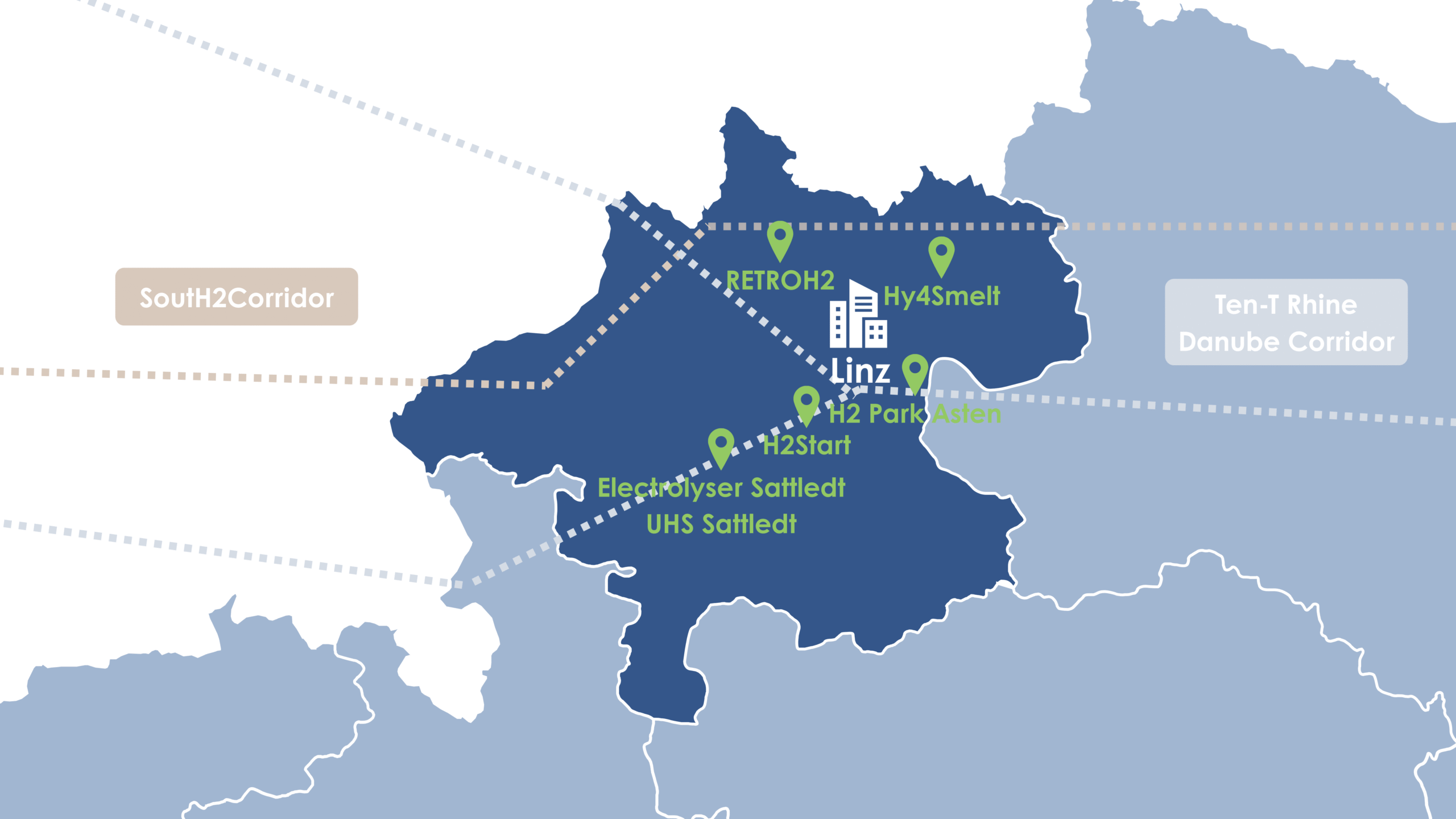
Upper Austria is Austria’s industrial heartland. As a Member of the European Climate Alliance, the region has committed to climate protection and has goals to establish 100% renewable electricity & heating by 2040. The SoutH2Corridor will potentially connect Upper Austria to Germany. In the city of Sattledt, the transportation corridor Ten-T Rhine Danube marks a regional crossroads of potential hydrogen distribution with the HI2 Valley.
Hy4Smelt
Building on the Future
The project Hy4Smelt demonstrates a breakthrough process of hydrogen-based, CO2-neutral reduction and melting of non-agglomerated low/medium-grade iron ore, meeting objectives set by the EU on clean steel technologies, sustainability, and competitiveness.
The Hy4Smelt industrial-scale demonstrator is first-of-its-kind worldwide in processing ultra-fine iron ores in an innovative fluidised bed direct reduction with 520 tonnes of 100 % green H2 per year from the H2Future plant (longest running PEM electrolyser worldwide, commissioned in 2019) and melting the direct reduced iron in a renewable powered electric furnace to produce 8000 tonnes of hot metal.
Hy4Smelt will enable the transformation towards a H2-based, sustainable and circular steel production, substantially reducing CO2 emissions and preparing the steel sector to be integrated into the hydrogen economy.
Involved partners: K1-MET
H2 Park Asten
Clear flows
The H2 Park Asten project explores innovative hydrogen production at the Linz-Asten wastewater treatment plant – Austria’s second largest. By integrating hydrogen generation into the plant’s already highly energy-efficient operations, the project leverages synergies such as waste heat and by-products to maximize sustainability.
H2 Park Asten is a key step in transforming the site into a modern Energy Park, expanding renewable energy through solar power and optimizing overall energy output. This initiative delivers environmental and economic benefits for the region, setting new standards for clean energy solutions.
Involved partners: Linz AG
H2UPSTAGE
Hydrogen Storage and Generation in Upper Austria
As one of the largest energy storage operators in Europe, RAG Austria is a pioneer in hydrogen production, storage, and utilization, and is therefore part of the HI2 Valley.
Hydrogen is a key component of a CO₂-neutral energy system, and the company has been deeply engaged in this field for over ten years. Within the project, RAG plans to implement electrolysis capacities along the H2Start Network and develop an underground hydrogen storage facility.
A particularly important aspect of hydrogen is its ability to be stored and transported in large volumes using existing, largely invisible infrastructure. This ensures the availability of green energy even during seasonal or weather-related dips in renewable generation.
Stored hydrogen can be transported via the H2Start Network to customers or other projects such asHy4Smelt and H2 Park Asten.
Involved partners: RAG Austria AG
H2Start Network
Getting on the grid
Trailers and trains to transport hydrogen are well and good for many projects, including most in HI2 Valley. But for hydrogen to flow at scale, pipes will be needed.
Converting a 30-kilometer gas line between the cities of Linz and Sattledt, the H2Start Network is an ambitious investment to secure hydrogen distribution for several HI2 Valley projects in Upper Austria.
The project, undertaken by the power and distribution company Energie AG Oberösterreich, also involves construction of a new 7-kilometer pipeline allowing for hydrogen transportation between the cities of Asten and Ebelsberg.
The network will establish piped hydrogen distribution between valley projects H2 Park Asten and Electrolyzer Sattledt & UHS Sattledt.
Involved partner: Energie AG Oberösterreich
RETROH2
Hydrogen river
‘Wasserstoff’ (literally: ‘Water Matter’) is the common name for hydrogen in German – and the RETROH2-project honours the term.
This project encompasses a pre-feasibility study by Pro Danube to determine whether the vessel serving as port pusher in the vicinity of the port of Linz (VOEST port) can be converted to use clean hydrogen as fuel, instead of burning fossil fuels.
Involved partner: Pro Danube International